


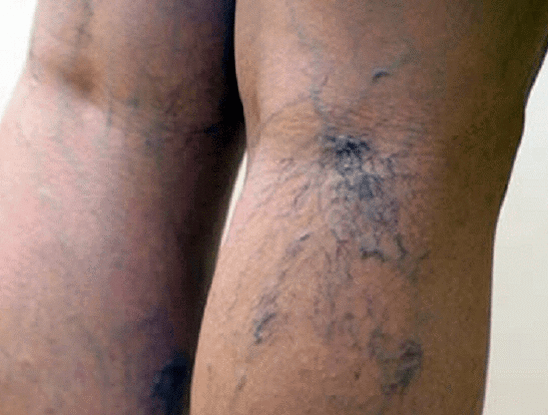
Varicose veins in the legs are characterized by the formation of sac-shaped expansions of the superficial (subcutaneous) veins of the lower extremities, their snake-like convolutions, an increase in length due to impaired outflow of blood through them and stagnant changes in the lower extremities.
The term “varicose veins” comes from the Latin word varix, which means “twisted, intertwined.”
Varicose veins have been known to mankind since ancient times.When conducting archaeological research during the excavations of the Mastaba burial in Egypt from 1595 to 1580. BC, a mummy with signs of varicose veins and treatment for a venous trophic leg ulcer was found.
This disease is rightly considered the price that humanity pays for the ability to walk upright.On average, in economically developed countries, about 15% of men and up to 25% of women (including pregnant women) suffer from varicose veins on the legs.The high-risk group includes women, overweight people and people who have jobs that place constant strain on the lower limbs and whose work requires standing or sitting for long periods of time.
Classification
Taking into account the predisposing factors for the development of the disease, primary and secondary varicose veins in the legs are distinguished for various reasons.
- Primarydevelops with varicose veins.In varicose veins, it is primarily the superficial veins that change, while the deep veins have a normal structure and function.For a long time, varicose veins of the superficial veins manifest themselves only as a cosmetic defect, but later, as the disease progresses, disorders of venous outflow occur, leading to pain in the lower extremities, swelling of the feet and legs, darkening of the skin in the lower third of the leg, inflammatory changes and trophic ulcers.Varicose veins are a continuously progressive disease.
- Secondaryis a complication of deep vein disease, in particular it arises either as a result of congenital malformations of the venous system (fistulas, congenital dysplasia, etc.) or after phlebothrombosis.Phlebothrombosis is a complex process of thrombus formation in the deep main veins of the lower extremities, thereby disrupting blood flow through the deep veins.Over time, the blood clot that forms in the vein solidifies and holes appear in it, through which restricted blood flow is possible, but the venous valves at the site of the blood clot scar and no longer prevent the blood from flowing back.As a result of dysfunction of the valves of the deep veins, blood begins to flow up and down through them, flowing back into the superficial veins and secondary varicose veins appear.This creates favorable conditions for venous stagnation, especially in the lowest parts of the extremity - the foot and lower leg.
Symptoms of varicose veins
For most people, varicose veins are a cosmetic defect, usually on the inside of the legs.Sometimes varicose veins can only appear in the form of a venous network that occurs when small diameter veins change, most commonly in the legs and less commonly in the face or upper extremities.Varicose veins are blue or dark purple in color and have a tortuous course.
Symptoms of varicose veins: fatigue, heaviness, aching pain, burning and tingling, throbbing, itching, cramps and anxiety.One of the symptoms may also be the appearance of swelling in the legs.As a result of a pronounced expansion of varicose veins, there may be a violation of the blood supply to the tissues of the lower extremities, skin defects may appear in the form of darkening or redness, as well as inflammation.In extremely advanced cases of varicose veins, trophic ulcers develop.
Diagnosis of varicose veins
To make a diagnosis, the doctor first examines the patient, paying particular attention to the appearance and swelling of the lower extremities.You may also be asked a series of questions about your sensations to clarify the nature of the pain.Another important step is to conduct a series of tests to assess the functional status of the superficial and deep veins.And finally, conducting an ultrasound Doppler examination of the main veins of the lower extremities.The ultrasound examination method allows the doctor to see the structure and function of the veins of the lower extremities and detect venous blood clots.
At the first symptoms of illness, you should contact doctors who deal particularly with diseases of the blood vessels and veins (general surgeon, vascular surgeon and phlebologist), and if skin damage occurs, you should also consult a dermatologist.Only after visiting specialists on their recommendation can you visit a cosmetic clinic.
Prevention of varicose veins
There is currently no method that would completely prevent the development of varicose veins.Thanks to prevention, it is possible to improve muscle tone, which helps to improve microcirculation in tissues, improves the condition and function of the veins of the lower extremities and reduces the risk of complications.The traditional and most widespread methods of prevention are as follows:
- Physical activity.Move more.Your legs should be constantly moving.Walking creates more favorable conditions for blood circulation in the lower extremities.Consult your doctor.It will help you choose the optimal type and level of physical activity.
- Control your weight.Being overweight increases the strain on the circulatory system and especially the veins.In addition, with excessive salt consumption, edema increases the most due to the accumulation of fluid in the body.
- Be careful what you wear.Avoid high heels.Your shoes should always be comfortable.When you wear low-heeled shoes, the muscles of your lower limbs work much better, resulting in better venous drainage.You should also avoid wearing uncomfortable and tight pants and skirts.
- Raise your feet.Raising the legs improves venous blood flow from the lower extremities.Try to take a few breaks throughout the day and put your feet up.For example, lie on your back and place your feet on a pillow.
- Avoid standing or walking for long periods of time.To improve blood circulation, try to change the position of your body as often as possible.Try to get up and walk every 30 minutes.
- Don't sit cross-legged.Sitting cross-legged creates unfavorable conditions for blood circulation in both lower extremities.
To prevent varicose veins, wearing stockings, knee-high socks and socks with compression effect is a good way.It can also be a good addition to the main treatment (medicinal or surgical).Currently, pharmacies offer a wide range of compression clothing.
Treatment of varicose veins
There are several generally accepted methods for treating varicose veins on the legs:
- conservative (medications and compression therapy).
- surgical.
Conservative treatment
Doctors consider elastic compression to be the most effective conservative means of treating and preventing varicose veins - the use of special compression stockings (stockings, golf, tights).When wearing this knitwear, uniform pressure is ensured on the lower extremities, which promotes normal blood circulation and improves its outflow, while at the same time forming, as it were, an external frame that supports weakened vascular walls.This reduces the load on the veins, improves the outflow of venous blood, reduces the speed of further progression of the disease and reduces the risk of thrombosis development.
Modern compression stockings are divided into two types: therapeutic and preventive.Every medical device is marked in mmHg and is divided into classes I to IV accordingly.At different stages of the disease, compression of a certain strength is used and it is necessary to consult a doctor, since only a doctor can prescribe and select the right compression stockings, taking into account the type of pathology and according to certain individual standards.
If you lead a sedentary lifestyle, as well as during prolonged physical activity, during pregnancy or if you have a hereditary predisposition, it is recommended to wear preventative compression stockings and tights.If even mild signs of varicose veins appear, you should immediately contact a specialist clinic.
Drug therapy can relieve the clinical manifestations of the disease - pain, swelling, discomfort, cramps, etc. - but cannot completely stop the progression of the disease and is now used only as part of complex therapy during the main surgical treatment.Unfortunately, most of the medications available on the pharmaceutical market today for the treatment of varicose veins have a rather low effectiveness, despite their theoretically justified use.One of the reasons for this is the low absorption of the underlying drugs by the body.It is possible that increasing the dose of the drug taken would be helpful in this situation, but this is associated with an increased risk of complications and side effects.Another reason for the low effectiveness of these drugs is that their spectrum of action is relatively narrow and is aimed at a specific connection in the development and progression of the disease.And to achieve the optimal effect, a complex effect on the disease and the use of several medications is necessary.An ideal medication for the treatment of venous insufficiency and varicose veins should influence as many pathogenetic connections of chronic venous insufficiency as possible, have as few side effects as possible and be well absorbed by the body.
Surgical treatment
Today, surgical treatment of varicose veins on the legs does not require a long hospital stay.Thanks to the use of modern invasive treatment methods, the removal of varicose veins can be carried out not only under anesthesia with the patient completely disabled, but also under local anesthesia, with only the pain sensitivity of the lower extremities being eliminated when conscious.Varicose veins disappear on their own without treatment within 3 months after delivery.
The following surgical treatment methods are available:
- Sclerotherapy.During this procedure, a solution is injected, under the influence of which a scar is formed at the site of the damaged vein.This method is only applicable for small and medium caliber varicose veins.Occasionally, not just one but multiple injections of a sclerotherapy solution are required for the vein to disappear completely.When carried out correctly, sclerotherapy is very effective, less traumatic, leads to good therapeutic and cosmetic effects and a significant advantage is that sclerotherapy is carried out under local anesthesia (i.e. without anesthesia) directly in the doctor's office.
- Laser surgery.Laser radiation can be used to remove varicose veins of any diameter and especially venous networks.The essence of the method is to irradiate the inner surface of the vein with a laser beam.Through a small puncture in the skin and vein wall, a special device is inserted - a light guide through which a laser beam is guided under ultrasound control.The inside of the vein is irradiated with a laser and then glued together.In this method, the doctor directs a laser beam at the vein to be removed, causing the vein to slowly discolor and disappear completely.An important advantage of this method is that no incision is made into soft tissue or skin.Using the laser method, it is possible to eliminate damaged veins and heal trophic ulcers on the lower leg.
- Surgical removal of varicose veins.Surgical excision involves making a series of small incisions in the skin and soft tissue through which the damaged vein is removed and inadequate perforating veins of the leg are ligated.Anesthesia is a necessary prerequisite for this technique.This method removes large varicose veins.
- Outpatient phlebectomy (removal of varicose veins).This method is suitable for removing veins with a small diameter.In this method, the vein is removed through several small incisions in the skin under local anesthesia.The scars left after removal are small and almost invisible.
- Endoscopic removal of varicose veins.This method is particularly suitable for the development of skin defects in the form of ulcers.With this method, a special video microcamera is inserted into the vessel, which allows you to view the vessel from the inside and observe the entire sampling process.The vein is then removed under observation through this camera.
By using modern treatment methods, complete healing and a good cosmetic effect are possible.However, it should be borne in mind that varicose veins can recur.
Complications of varicose veins
Occasionally, changes ranging from pronounced darkening to ulcerative skin defects can occur on the skin around varicose veins due to impaired blood microcirculation.If these changes occur, you should consult a doctor immediately.
Another more serious complication of varicose veins is the formation of blood clots in the deep and superficial veins.This complication is called thrombophlebitis.When it occurs, there is acute, unbearable pain, swelling and redness.In this situation, too, you should consult a doctor immediately.
Causes of varicose veins
The true nature of varicose veins is not clear enough.According to most scientists, varicose veins are hereditary and genetic.The main cause is weakness of the venous wall and dysfunction of the venous valves.Venous valves arise on the walls of the veins and usually have two valves facing the heart.When the venous valve is closed normally, blood from the section of vein above cannot penetrate into the section below.When the function of the valves is impaired and the valves do not close completely, the blood moves up and down, causing venous stagnation and dilatation of the veins below the valve with impaired function.First of all, a varicose vein appears in the place where there is a valve with impaired function, and the blood flows towards from the deep veins to the external ones, the crowded vein expands and expands, causing stretching and dysfunction of the underlying valve, etc.Gradually, disturbances in the outflow of venous blood from the lower extremity to the heart occur, as a result of which the microcirculation of blood in the tissues of the lower extremities is disrupted, which is manifested by edema, increased pigmentation, thrombophlebitis and trophic ulcers.
Factors in the development of varicose veins
Factors that contribute to varicose veins may include:
- Genetic predisposition – thin and weak wall of superficial veins.
- Increased strain on the veins: sedentary work, prolonged standing, wearing uncomfortable high-heeled shoes, lifting heavy objects, lack of exercise in the lower leg muscles.Pregnancy and childbirth are also triggering factors for the development of varicose veins.During sudden physical overexertion, there is a sharp increase in hydrostatic pressure in the veins of the lower extremities, which triggers the process of varicose vein formation.
The risk factors for the development of varicose veins also include:
- Age.As we age, the walls of the veins and valves become thinner, which leads to natural dysfunction.
- Floor.Women are more likely to suffer from varicose veins.It is possible that this is due to a number of hormonal reactions.Female sex hormones influence the relaxation process of the vein wall.During pregnancy and childbirth, during the menstrual cycle and during menopause, pronounced hormonal changes occur in the female body, which inevitably affect the functioning of the venous system.The influence of taking hormonal contraceptives on the course of varicose veins cannot be ruled out.
- Obesity.If you are overweight or obese, the load on the veins of the lower extremities increases.
- Pregnancy and birth.In pregnant women, the volumetric load in the body increases, but at the same time the speed of blood outflow from the lower extremities to the pelvic cavity into the system of the inferior vena cava and to the heart decreases.This creates favorable conditions for the development of varicose veins.Changes in the circulatory system in a woman's body ensure the development of the fetus, but at the same time cause the development of varicose veins.As pregnancy progresses or during childbirth, varicose veins can appear not only in the lower extremities, but also in the hemorrhoidal veins around the anus.